


Release time:2026-10-28 10:21:13 view count:64
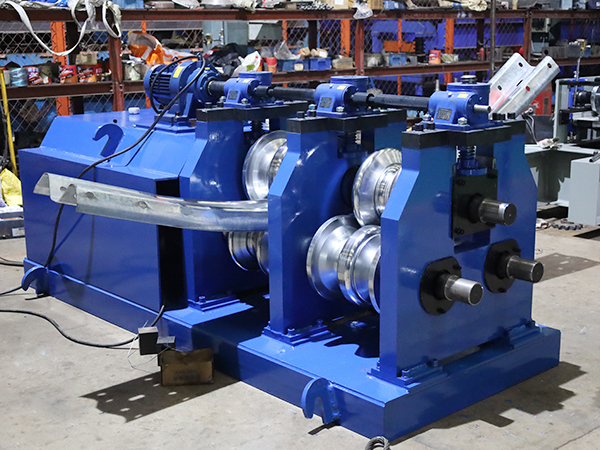
Straight guardrail is made by roll forming; curved guardrail is made by bending that rail afterwards. Every road with a curve, every interchange ramp and every median that swings needs rail set to a radius, and that work belongs to a dedicated curving or bending machine. It is a smaller, simpler machine than a forming line, but the demands on it are unforgiving: the radius has to be right, and it has to be the same along a run of hundreds of metres that drivers will pass at speed.
A barrier works by guiding a vehicle along a controlled path, and on a curve that path is an arc. Rail that is forced to follow a curve without being bent to it fights the bolts and the posts, pulls joints open and leaves the face uneven. Standards and installation guides treat curved sections as parts in their own right, specified by radius and direction, not as straight rail bent on site. Producing those sections properly is a service in itself, and the workshops that do it well tend to hold the local business, because a mis-curved run of rail is discovered only after the posts are in the ground.
Two methods dominate. Roll bending passes the rail through driven rollers whose positions set the radius, bending continuously along the whole length; it suits long radii and repeated production of the same curve. Press bending forms the curve in a series of discrete bends between a press die and supports, which reaches tighter radii and handles the stiff, thick W beam section well, but each piece passes through a set-up cycle. Many workshops that supply road projects run both: roll bending for gentle curves in quantity, press bending for tight radii and short pieces. The choice follows the rail schedule, not the price of the machine.
Hot-dip galvanised coating is brittle in bending, so curving after galvanising risks cracking the zinc and exposing bare steel exactly where splash and grit concentrate. Curving before galvanising keeps the coating intact, which is why the usual production route is form, curve, then galvanise. The catch is that the workshop must hold curved stock through the galvanising cycle and match it back to the order afterwards, which is a logistics exercise as much as a production one. Some crews do curve finished rail for very gentle radii, but they should know their coating supplier's limits before promising it.
Steel does not hold exactly the shape it was bent to; it springs back when released, and W beam rail with its stiff ribs springs back noticeably. Every radius therefore begins with a trial piece: bend, release, measure the actual radius against a template, adjust, repeat. A good operator keeps a record of settings against radii for each rail section, so the second job of the same radius starts where the last one ended. Machines with digital roll position or stroke settings make that record mechanical instead of memory, and the difference shows on repeat orders.
A curve that wanders is worse than a slightly wrong curve, because installers set posts to the rail and a wandering radius turns into visibly uneven post spacing. Consistency comes from three things: consistent feeding, so each piece enters the rolls the same way; stable settings that do not drift with temperature and wear; and measurement of each piece against a template or radius gauge before it leaves the shop. On long jobs, checking the first and last pieces of every batch is the habit that separates a tidy installation from a disputed one.
Curving is fast per piece compared with forming, but the handling is not: rail sections are long, heavy and springy, and they need tables that support them without kinking. The bottleneck is usually moving and sorting pieces by radius and direction, not bending them. Plan the flow around the machine accordingly, with clear labeling of each curved batch, and the machine will never be the constraint. A workshop that produces straight rail as well can share decoilers and space, but the curved stock should be racked separately, since a straight piece mixed into a curved batch is found on site, not in the shop.
State the rail sections you handle, the range of radii on your road projects, and whether work arrives galvanised or to be galvanised afterwards. Ask whether the machine sets positions numerically or by manual adjustment, and what tooling change is involved between W beam and other sections. Ask for a trial bend on your rail, measured after release, since that is the only honest demonstration. A manufacturer that talks in radii, springback and batch records knows this trade; one that quotes only tonnage does not.
American Association of State Highway and Transportation Officials. AASHTO M180, Corrugated Sheet Steel Beams for Highway Guardrail.
American Association of State Highway and Transportation Officials. AASHTO Roadside Design Guide.
American Society for Testing and Materials. ASTM A123/A123M, Standard Specification for Zinc Coating on Iron and Steel Products.
European Committee for Standardization. EN 1317, Road restraint systems.

Copyright © 2026-2027 Mingmu Roll Forming Machinery Manufacture All Rights Reserved