


Release time:2026-10-28 10:23:38 view count:194
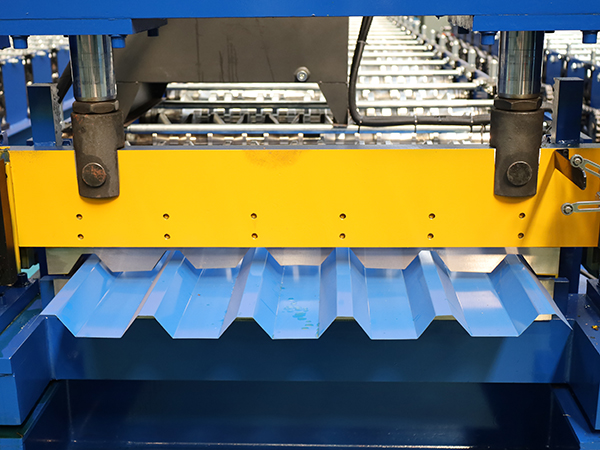
Given a profile drawing, a sheet of steel and a quantity, there are usually two ways to make the part: bend it up on a press brake, or roll form it through a line of dies. Both produce a good profile. What differs is the economics, the tolerances and the kind of order each process likes. Choosing between them is less about which machine is better and more about which one matches the work you actually have.
A press brake forms a profile by making a series of bends in a die, one stroke at a time, one length at a time. Its cost per part is roughly proportional to the number of bends and the length of the part, and it barely falls with volume. Roll forming pushes strip continuously through matched roll sets, so cost per metre falls steeply with length and quantity. The crossover is not a fixed number, but the pattern is: short parts, low quantities and frequent changes favor the press brake; long parts and steady quantities favor roll forming. Costing a typical week of orders against both routes settles it faster than any general rule.
Roll forming is largely indifferent to length. A six-metre panel costs barely more per metre than a two-metre one, and the line keeps producing while the operator changes nothing. A press brake must handle each part individually, so long parts mean handling time, table extensions and slow cycles, and cost per metre rises with every extra metre. Conversely, roll forming has a setup and tooling cost that must be paid whether you make a hundred metres or a hundred thousand, so thin order books drown in it. Volume per profile is the first number to look at, length the second.
A press-bent part is only as consistent as its setup; between the first bend and the last, small variations creep in, and on a three-metre part they are hard to see and hard to prevent entirely. Roll forming passes every centimetre of the strip through the same rollers, so the cross-section is essentially identical from end to end, and from part to part across the day. For products where the profile interlocks, nests or must present a uniform face, such as panels, purlins and decking, that along-length consistency is the decisive argument, and no amount of careful press braking fully reproduces it.
The press brake is a generalist. One machine and a shelf of standard dies make hundreds of different profiles, and a new shape is often a new program rather than new tooling. Roll forming is a specialist: each profile carries its own roll sets, designed for it, and changing profiles means changing tools or running a machine built for a pair of them. That tooling cost is the real price of roll forming's speed, and it is why formed profiles are quoted by quantity. A workshop with genuinely varied, low-volume work will lean press brake; one with a few profiles in real volume will lean roll forming and never look back.
Press brakes bend thick material happily; that is what they are built for, and heavy plate beyond roll forming's usual range is brake territory. Roll forming works best in light to medium gauges, roughly the range from thin painted coil up to a few millimetres, where its gentle, progressive bending also protects coatings better than a single sharp stroke. Deep sections with tight inside bends are easier on a brake; long, open profiles with many gradual bends are roll forming's home ground. Matching the process to the gauge and depth avoids buying a machine to fight its nature.
A press brake integrates naturally with other single-part operations: the same shop punches, notches and forms on the same equipment, one part at a time. Roll forming builds these operations into the line itself, with punching before forming and cutting at the end, so a finished part leaves the line complete. That integration is a strength at volume and a commitment at design time, since the hole pattern belongs to the tooling. Decide early which features belong to the profile and which are added later, because the answer shapes the tooling quote more than the profile shape does.
In practice the processes are complements more than competitors. Fabricators run roll forming for the profiles that justify tooling, and a press brake for brackets, flashings, closures and everything that arrives in odd quantities. Panel and purlin suppliers often buy rolled sheet and brake the trims to match it. When evaluating suppliers or planning a workshop floor, the useful question is not which process wins in the abstract, but which process each product on the order list belongs to. Answer that honestly and the equipment list mostly writes itself.
ASM International. ASM Handbook, Volume 14B, Metalworking: Sheet Forming.
Halmos, G. T. Roll Forming Handbook, Marcel Dekker.
American Iron and Steel Institute. AISI S100, North American Specification for the Design of Cold-Formed Steel Structural Members.
ISO. ISO 9001:2015, Quality management systems - Requirements.

Copyright © 2026-2027 Mingmu Roll Forming Machinery Manufacture All Rights Reserved