


Release time:2026-11-19 09:37:30 view count:183
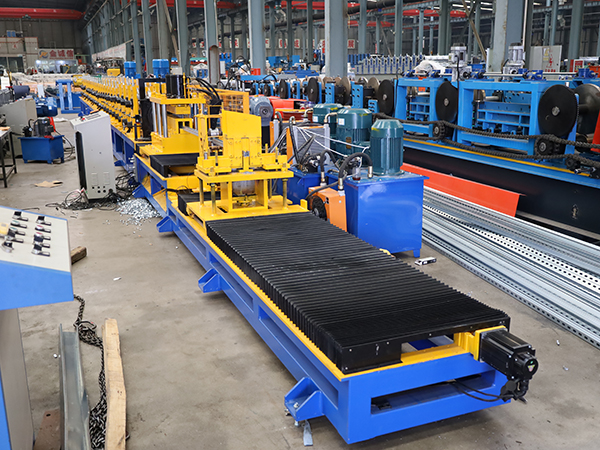
A solar array is only as dependable as the structure holding it in place. Behind every rooftop array, ground-mounted plant, carport or hillside installation sits a family of rails, channels, clamps and brackets that must stay aligned for decades while carrying wind, snow and thermal movement. For buyers of production equipment, that shifts the question from simply owning a roll former to understanding whether a solar panel bracket roll forming machine can turn coil into mounting components with repeatable geometry. Mingmu's photovoltaic mounting bracket forming machines were developed specifically for this job, producing rails, C-shaped steel profiles, U-shaped brackets and roof-mounted photovoltaic clamps from galvanized or cold-rolled steel strip. This guide walks through what the line does, how profiles are specified, and which checks matter before a machine is accepted and shipped.
A photovoltaic mounting bracket line is a continuous process rather than a set of separate stations. The machine integrates uncoiling, leveling, continuous cold bending, punching and hydraulic cutting in one sequence. Strip enters from the decoiler, is flattened, passes through successive forming stands that gradually create the section, receives holes at the programmed positions, and is cut to the required length. Because forming, punching and cutting share one control system, the relationship between the profile cross-section and the hole pattern stays consistent from the first piece to the last.
Mounting systems are assembly kits: a rail that is slightly too narrow, or a hole pattern that drifts along its length, slows installation even when the steel is sound. Mingmu's machines use a welded frame of thickened steel plate for rigidity, with alloy-steel rollers that are quenched, precision turned and polished.
Photovoltaic mounting is not a single profile. A well-specified line should be judged against the parts your projects actually require. Mingmu's photovoltaic mounting bracket forming machine produces four broad families.
Photovoltaic rails. These longitudinal members carry module clamps across a row. Straightness and consistent web height matter because a bent rail loads every clamp unevenly.
C-shaped steel profiles. C sections serve as purlins and support members in larger arrays. Flange perpendicularity and repeatable channel height decide how easily splices fit.
U-shaped brackets. U channels act as carriers around mounting hardware. Stable inner width lets mating parts slide in without force.
Roof-mounted photovoltaic clamps. These smaller components fix the array to the building surface. Hole position and edge quality matter because clamps are handled in bulk.
Quick roller changes let one line serve rooftop and ground-mounted projects. Custom profiles, hole spacing and height adjustments can be built to customer drawings.
Outdoor mounting hardware lives in a corrosive environment, so material selection is part of the machine specification rather than an afterthought. The line processes black steel, galvanized steel and high-zinc-coating galvanized strip, with adjustable sheet thickness to suit different component designs. Cold-rolled strip and galvanized strip are both used as raw materials, depending on the corrosion protection strategy of the finished part.
When you specify a line, describe the coating condition of the coil you intend to run and the environment of the finished installation. A coating that performs adequately on an inland commercial roof may be a poor choice for a coastal or high-humidity site. The forming process itself should not be asked to compensate for an unsuitable material: rollers that polish the strip and controlled feeding help preserve the surface, but the protective system begins with the coil.
Ask how the line handles coated versus uncoated strip, since tooling set for one surface can mark another. Request samples in the material you intend to buy and inspect the formed face before approving tooling.
Photovoltaic components are mass-produced, but they are assembled by people on uneven roofs and uneven ground. Small deviations become expensive at that stage. Mingmu describes produced profiles as having smooth surfaces, good perpendicularity and minimal dimensional deviation, supported by spindles and forming wheels that are precision ground and calibrated for concentricity and parallelism during manufacture.
Three areas deserve particular attention during acceptance testing. First, check cross-section consistency along a full length, not just at the cut end of a short sample. Second, measure hole position relative to the formed web or flange, since the punching operation is linked to the length-setting and counting functions. Third, inspect cut edges for burrs that could affect handling or coating life.
Bring your mounting drawing to the factory test. Lay out a rail, C profile, U bracket and clamp as they would be installed and check that holes line up without forcing; this reveals more than isolated measurements.
The line is equipped with PLC-based control and a touchscreen interface. Automatic punching, length setting, cutting and counting are handled through the control system, which reduces reliance on manual measurement and makes operator training more straightforward. For a workshop supplying several projects at once, that consistency is as valuable as forming speed: the settings that produced an accepted batch can be recalled for the next order.
Changeover is the other operational consideration. Quick roller changes allow a supplier to move between photovoltaic C channels, U channels, rails and brackets without dedicating a separate line to each profile. When you review a machine configuration, confirm which tooling comes with the line for each of your required sections, and how the hole pattern is programmed for each part.

A documented inspection routine is a better indicator of machine quality than a brochure claim. Mingmu's stated process begins with incoming inspection of steel plates, rollers, spindles, motors and electrical components, with non-compliant material rejected. Machining precision is then verified by grinding and calibrating spindles, forming wheels and drive shafts for concentricity and parallelism.
After assembly, the machine runs a two-to-four-hour no-load test to confirm smooth transmission, rotation and lifting movement. A production run with actual steel sheet follows, checking profile dimensions, flatness and cut edge quality. The electrical side is inspected separately: the CNC system, counter, cutting mechanism and emergency stops are all tested. Final factory acceptance covers cleanliness, accessories and documentation before shipment is authorised.
Ask for the production-run sample to be kept and shipped with the machine, giving your team a baseline at commissioning.
Long, heavy forming lines travel in sections. Mingmu packs electrical cabinets, tools and manuals in separate wooden crates, wraps precision parts such as rollers individually, and protects the whole machine against rain, moisture and impact with stretch film and reinforced packaging suitable for container transport. Large components are loaded in sections for crane-assisted unloading, and the machine is secured with steel wire ropes and wooden blocks to prevent movement in transit.
On arrival, check the packing list against the crates before signing off: confirm each wrapped roller set, cabinet and manual bundle is present, and photograph moisture or impact damage before unloading. Make sure the site crane, foundation and power supply are ready for the installation team.

The first mistake is buying by machine length alone. A longer line is not automatically better at holding the tight hole-to-profile relationship that mounting systems need; ask how punching and cutting are synchronized instead.
The second is treating brackets as interchangeable. Clamps, C purlins and rails place different demands on flange geometry and edge finish; list every profile and hole pattern, then confirm the tooling covers them.
The third is overlooking the line's beginning. Uncoiling and leveling set how strip enters the first stand, and poor entry shows up later as twist. Include these stations in acceptance testing.
The fourth is leaving support out of the purchase discussion. Mingmu provides installation and commissioning videos and manuals, on-site guidance, wear parts at long-term low cost, lifetime maintenance advice and a one-year machine warranty. Clarify which services apply to your order and keep spare-parts contacts with the documentation.
Which profiles can one photovoltaic bracket forming machine produce? It produces photovoltaic rails, C-shaped profiles, U-shaped brackets and roof-mounted clamps. Quick roller changes support switching, and custom profiles can be built to drawings.
Can the line run galvanized and high-zinc-coating strip? Yes. It runs black steel, galvanized steel and high-zinc-coating strip, with adjustable sheet thickness.
How is hole position kept consistent along a rail? Punching, length setting, counting and cutting are controlled by the PLC and touchscreen. Measure a full-length sample against your mounting drawing during acceptance.
What testing happens before shipment? Incoming material and machining checks, a two-to-four-hour no-load run, a production run with real sheet, electrical and emergency-stop checks, and final acceptance.
Is installation support available overseas? Mingmu supplies installation and commissioning videos, manuals and on-site guidance, plus ongoing maintenance advice.
Can the machine be adapted to a non-standard mounting design? Yes. Equipment can be tailored to drawings, including special profiles, hole spacing and height adjustments.
A solar panel bracket roll forming machine is a long-term production decision, not a one-off purchase. The right line combines an integrated uncoiling-to-cutting process, stable tooling for rails, C and U sections and clamps, a control system that keeps punching and length setting repeatable, and a documented inspection routine before shipment. Define your profile list and mounting drawings first, test the machine with the coil you will really use, and treat packaging, commissioning and spare parts as part of the specification. That approach turns a forming line into a reliable source of components for rooftop, commercial, industrial and ground-mounted photovoltaic projects.
[1] IEC 61215-1: Terrestrial photovoltaic (PV) modules – Design qualification and type approval.
[2] IEC 61730-1: Photovoltaic (PV) module safety qualification – Requirements for construction.
[3] ISO 1461: Hot dip galvanized coatings on fabricated iron and steel articles – Specifications and test methods.
[4] ISO 9227: Corrosion tests in artificial atmospheres – Salt spray tests.
[5] EN 1090-1: Execution of steel structures and aluminium structures – Requirements for conformity assessment of structural components.
[6] ISO 6892-1: Metallic materials – Tensile testing – Method of test at room temperature.
[7] ISO 9001: Quality management systems – Requirements.

Copyright © 2026-2027 Mingmu Roll Forming Machinery Manufacture All Rights Reserved