


Release time:2026-05-27 15:50:59 view count:77
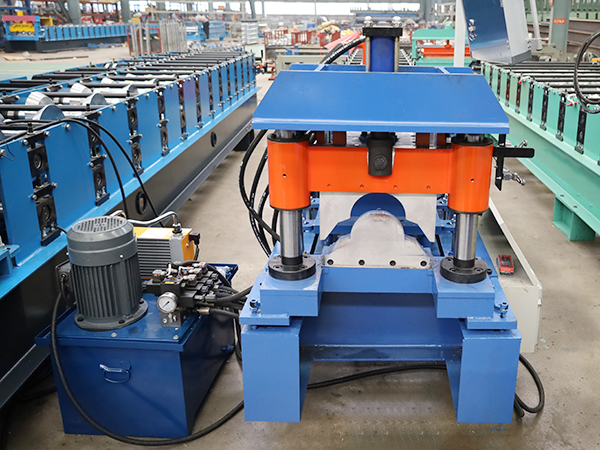
All finished ridge caps are consistently longer or shorter than the preset value. The deviation remains stable across the entire production batch.
Each product shows different lengths without a fixed pattern. Dimensional consistency is poor and unpredictable.
The cutting length slowly increases or decreases during continuous production. The deviation accumulates over time.
Loose, displaced, or worn encoders, sensors, and counting switches cause signal delay or loss. Aging wiring and poor electrical contact also lead to incorrect length measurement.
Inconsistent feeding speed, roller slip, or intermittent movement causes mismatch between actual and calculated travel distance. Material wandering or resistance variations further affect accuracy.
Loose fasteners in the cutting unit, roller frames, or transmission system cause positional drift. Deformed guide rails or rollers alter the material path and effective length.
Insufficient clamping force allows material movement during cutting. Delayed cutter response or incomplete reset changes the actual cutting position.
Incorrect synchronization between feeding speed and cutter timing leads to systematic deviation. Unauthorized parameter changes worsen instability.
Uneven thickness, curled edges, or poor flatness create unstable friction during feeding, leading to slipping and length errors.
Check encoder and sensor mounting firmness. Retighten loose brackets and adjust sensing distance. Replace faulty components and recalibrate the length measurement system.
Inspect roller gaps, wear conditions, and guide rails. Adjust gaps to prevent slipping and ensure smooth material travel. Lubricate transmission parts to stabilize feeding speed.
Check all fasteners in cutting units, roller assemblies, and frames. Reinforce loose connections and replace worn rollers or deformed guide rails.
Ensure sufficient clamping force to prevent material movement during cutting. Inspect cutter stroke, response timing, and reset accuracy; repair or lubricate drive components if needed.
Restore standard factory parameters. Match feeding speed with cutting response time. Avoid frequent parameter changes and verify adjustments through trial cutting.
Trim curled edges and deformities before feeding. Separate materials with inconsistent thickness to reduce friction-related errors.
Run the machine at normal speed and continuously sample products. Adjust parameters gradually until cutting length stabilizes within tolerance.
Check sensors and encoders each shift. Clean dust and debris from sensing surfaces and perform periodic calibration.
Inspect rollers, gaps, and guide rails daily. Lubricate moving parts and correct slipping or wandering promptly.
Verify cutter action and clamping force before startup. Clean debris and lubricate moving parts to ensure smooth operation.
Record all approved operating parameters. Prevent unauthorized changes and validate any adjustment through trial production.
Reject materials with deformation, uneven thickness, or poor edge quality to reduce upstream instability.
Perform weekly calibration of the cutting and measurement system to eliminate gradual deviation.
Inaccurate cutting length in ridge cap roll forming equipment is mainly caused by detection system faults, unstable conveying, mechanical looseness, cutting mechanism issues, parameter errors, and raw material defects. By classifying deviation types and applying targeted troubleshooting methods, cutting accuracy can be effectively restored. Combined with routine inspection, calibration, and standardized operation, the system maintains stable performance and reduces defective output.

Copyright © 2026-2027 Mingmu Roll Forming Machinery Manufacture All Rights Reserved